Showing posts with label reviews. Show all posts
Showing posts with label reviews. Show all posts
Tuesday, May 29, 2012

Thursday, January 26, 2012
This Saturday, I'm hosting a talk with Singapore's top theatre reviewers!

It's the 4:30 Open Panel Discussion noted below:
Open Roads: Stage Talk -Theatre Talks Back and Open Panel Discussion
Saturday 28 January 2012, 2-6pm
Theatre Talks Back, 2-4pm
Open Panel Discussion, 4:30-6pm
The Substation Theatre
Admission: Free
This is an InHouse event
Open Roads: Stage Talk was a programme initiated by The Substation in collaboration with The Flying Inkpot Theatre and Dance in 2010 to invite members of the public to come together and converse about local plays. After two successful runs in 2010 and 2011, Open Roads: Stage Talk comes to a close.
*To end the programme on a high note, local theatre reviewers have been gathered for a final pow-wow session– an open panel discussion about the current state of theatre criticism and their personal processes of reviewing performances. Join Life! journalist Corrie Tan, TODAY journalist, Mayo Martin, local online arts journal The Flying Inkpot‘s Matthew Lyon and freelance reviewers, Ng Yi-Sheng and Tara Tan in an open discussion about local theatre. Look forward also to the first of our Theatre Talks Back sessions, where invited theatre practitioners will talk about their recent productions in a Q&A presentation.
The Theatre Talks Back session is hosted by invited theatre practitioners who will talk about their recent productions in a Q&A presentation. Cake Theatrical Productions will be showing a video presentation of Decimal Points: 4.44 and talking about the trials and tribulations of putting together the first co-presentation between The Substation and Cake Theatrical Productions.
Saturday 28 January 2012, 2-6pm
Theatre Talks Back, 2-4pm
Open Panel Discussion, 4:30-6pm
The Substation Theatre
Admission: Free
This is an InHouse event
Open Roads: Stage Talk was a programme initiated by The Substation in collaboration with The Flying Inkpot Theatre and Dance in 2010 to invite members of the public to come together and converse about local plays. After two successful runs in 2010 and 2011, Open Roads: Stage Talk comes to a close.
*To end the programme on a high note, local theatre reviewers have been gathered for a final pow-wow session– an open panel discussion about the current state of theatre criticism and their personal processes of reviewing performances. Join Life! journalist Corrie Tan, TODAY journalist, Mayo Martin, local online arts journal The Flying Inkpot‘s Matthew Lyon and freelance reviewers, Ng Yi-Sheng and Tara Tan in an open discussion about local theatre. Look forward also to the first of our Theatre Talks Back sessions, where invited theatre practitioners will talk about their recent productions in a Q&A presentation.
The Theatre Talks Back session is hosted by invited theatre practitioners who will talk about their recent productions in a Q&A presentation. Cake Theatrical Productions will be showing a video presentation of Decimal Points: 4.44 and talking about the trials and tribulations of putting together the first co-presentation between The Substation and Cake Theatrical Productions.
Wednesday, June 30, 2010
A review of "Over There: Poems from Singapore and Australia" in Cordite Magazine
It's a short review. The weird thing is, there are only three poets mentioned in the whole thing, and I'm the only Singaporean.
Click here: http://www.cordite.org.au/?p=9719
UPDATE: How blind of me. There are four poets, and Heng Siok Tian's the other Singaporean. D'oh!
Click here: http://www.cordite.org.au/?p=9719
UPDATE: How blind of me. There are four poets, and Heng Siok Tian's the other Singaporean. D'oh!
Friday, August 14, 2009
My review for The 25th Annual Putnam County Spelling Bee...
... kena censor by Straits Times in today's Life!. Sigh.
Don't really want fight, since I'm just doing it for the money. But the bit that got cut is the focal point of my review (and pretty damn scandalous, so I guess ST didn't want to cause a conservative uproar), so I reproduce it here, excised material in bold.
> theatre
The 25th Annual Putnam County Spelling Bee
Atlantis Productions, Inc.
Victoria Theatre
Wednesday
The 25th Annual Putnam County Spelling Bee is full of surprises. Sure, you might have expected this Tony Award-winner to be a song and dance extravaganza that inspires children to excel academically. Instead, it turns out to be a wonderfully mischievous drama, charming audiences young and old with its vivid characters.
The show takes a while to warm up. There is an energy missing from the first few scenes, as the cast sings too softly, moving without the exuberance one would expect of an opening. Even a song like “Pandemonium”, in which the contestants leap off their chairs in frustration, comes across as a little too tame.
However, as the players gain momentum, we warm to their roles. Johann Dela Fuente plays the endearing Leaf Coneybear, a child of hippies who feels out of place among all the geniuses, as he relates in his song “I’m Not That Smart”.
Another memorable figure is Nancy Park, an overachieving Korean-American girl played by Shiela Valderrama Martinez. After her solo, “I Speak Six Languages”, she dramatically forces herself to fail, encouraged by a kindly apparition of Jesus.
Extra spice is added through audience participation. Four “guest spellers” are invited on stage at every show, pretending to be students, and made to spell ridiculously obscure or ridiculously simple words – my night, guests got terms as varied as “pilgarlick” and “dog”.
Remarkably, these hapless guests are soon persuaded to join in some of the basic choreography, while the MC improvises commentary on their appearances, noting, for instance, how they were the first in their grade to grow facial hair.
The biggest surprise, however, is the level of adult humour in the show. This ranges from intellectual references to Nietzsche to shocking flashes of sequined panties under checkered skirts.
One character faces pressure from her gay fathers (their relationship is fairly dysfunctional, which is probably why the censors okayed it). Another character, played excellently by Felix Rivera, has a lament about the circumstances which caused him to misspell his word, entitled “My Unfortunate Erection”. Pretty funny stuff – and fortunately, it goes right over the heads of younger children.
Spelling Bee is not your typical big-budget musical, nor, in my opinion, is it brilliantly executed by this cast. Still, the power of the script and its lovable band of quirky characters shines through. Audiences can still expect a satisfying, rib-tickling evening at the theatre. Thankfully, no surprises there.
Don't really want fight, since I'm just doing it for the money. But the bit that got cut is the focal point of my review (and pretty damn scandalous, so I guess ST didn't want to cause a conservative uproar), so I reproduce it here, excised material in bold.
> theatre
The 25th Annual Putnam County Spelling Bee
Atlantis Productions, Inc.
Victoria Theatre
Wednesday
The 25th Annual Putnam County Spelling Bee is full of surprises. Sure, you might have expected this Tony Award-winner to be a song and dance extravaganza that inspires children to excel academically. Instead, it turns out to be a wonderfully mischievous drama, charming audiences young and old with its vivid characters.
The show takes a while to warm up. There is an energy missing from the first few scenes, as the cast sings too softly, moving without the exuberance one would expect of an opening. Even a song like “Pandemonium”, in which the contestants leap off their chairs in frustration, comes across as a little too tame.
However, as the players gain momentum, we warm to their roles. Johann Dela Fuente plays the endearing Leaf Coneybear, a child of hippies who feels out of place among all the geniuses, as he relates in his song “I’m Not That Smart”.
Another memorable figure is Nancy Park, an overachieving Korean-American girl played by Shiela Valderrama Martinez. After her solo, “I Speak Six Languages”, she dramatically forces herself to fail, encouraged by a kindly apparition of Jesus.
Extra spice is added through audience participation. Four “guest spellers” are invited on stage at every show, pretending to be students, and made to spell ridiculously obscure or ridiculously simple words – my night, guests got terms as varied as “pilgarlick” and “dog”.
Remarkably, these hapless guests are soon persuaded to join in some of the basic choreography, while the MC improvises commentary on their appearances, noting, for instance, how they were the first in their grade to grow facial hair.
The biggest surprise, however, is the level of adult humour in the show. This ranges from intellectual references to Nietzsche to shocking flashes of sequined panties under checkered skirts.
One character faces pressure from her gay fathers (their relationship is fairly dysfunctional, which is probably why the censors okayed it). Another character, played excellently by Felix Rivera, has a lament about the circumstances which caused him to misspell his word, entitled “My Unfortunate Erection”. Pretty funny stuff – and fortunately, it goes right over the heads of younger children.
Spelling Bee is not your typical big-budget musical, nor, in my opinion, is it brilliantly executed by this cast. Still, the power of the script and its lovable band of quirky characters shines through. Audiences can still expect a satisfying, rib-tickling evening at the theatre. Thankfully, no surprises there.
Wednesday, September 03, 2008
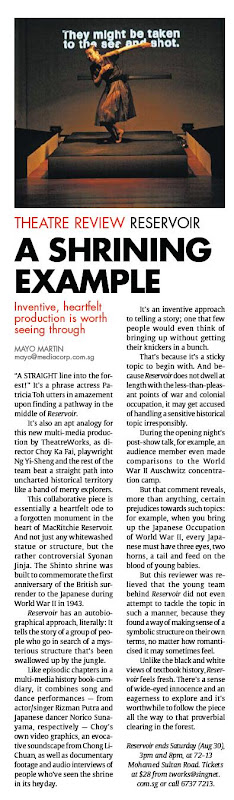
Reservoir Review (Today Weekend, 30 August 2008)
We rather like this review because it actually describes the problematics of the show's construction.
A Shrining example
“A STRAIGHT line into the forest!” It’s a phrase actress Patricia Toh utters in amazement upon finding a pathway in the middle of Reservoir.
It’s also an apt analogy for this new multi-media production by TheatreWorks, as director Choy Ka Fai, playwright Ng Yi-Sheng and the rest of the team beat a straight path into uncharted historical territory like a band of merry explorers.
This collaborative piece is essentially a heartfelt ode to a forgotten monument in the heart of MacRitchie Reservoir. And not just any whitewashed statue or structure, but the rather controversial Syonan Jinja. The Shinto shrine was built to commemorate the first anniversary of the British surrender to the Japanese during World War II in 1943.
Reservoir has an autobiographical approach, literally: It tells the story of a group of people who go in search of a mysterious structure that’s been swallowed up by the jungle.
Like episodic chapters in a multi-media history book-cum-diary, it combines song and dance performances — from actor/singer Rizman Putra and Japanese dancer Norico Sunayama, respectively — Choy’s own video graphics, an evocative soundscape from Chong Li-Chuan, as well as documentary footage and audio interviews of people who’ve seen the shrine in its heyday.
It’s an inventive approach to telling a story; one that few people would even think of bringing up without getting their knickers in a bunch.
That’s because it’s a sticky topic to begin with. And because Reservoir does not dwell at length with the less-than-pleasant points of war and colonial occupation, it may get accused of handling a sensitive historical topic irresponsibly.
During the opening night’s post-show talk, for example, an audience member even made comparisons to the World War II Auschwitz concentration camp.
But that comment reveals, more than anything, certain prejudices towards such topics: for example, when you bring up the Japanese Occupation of World War II, every Japanese must have three eyes, two horns, a tail and feed on the blood of young babies.
But this reviewer was relieved that the young team behind Reservoir did not even attempt to tackle the topic in such a manner, because they found a way of making sense of a symbolic structure on their own terms, no matter how romanticised it may sometimes feel.
Unlike the black and white views of textbook history, Reservoir feels fresh. There’s a sense of wide-eyed innocence and an eagerness to explore and it’s worthwhile to follow the piece all the way to that proverbial clearing in the forest.
Reservoir ends Saturday (Aug 30), 3pm and 8pm, at 72-13Mohamed Sultan Road. Tickets at $28 from tworks@singnet.com.sg or call 6737 7213.
mayo@mediacorp.com.sg
 |
| From Ng Yi-Sheng's Careerblog |
A Shrining example
“A STRAIGHT line into the forest!” It’s a phrase actress Patricia Toh utters in amazement upon finding a pathway in the middle of Reservoir.
It’s also an apt analogy for this new multi-media production by TheatreWorks, as director Choy Ka Fai, playwright Ng Yi-Sheng and the rest of the team beat a straight path into uncharted historical territory like a band of merry explorers.
This collaborative piece is essentially a heartfelt ode to a forgotten monument in the heart of MacRitchie Reservoir. And not just any whitewashed statue or structure, but the rather controversial Syonan Jinja. The Shinto shrine was built to commemorate the first anniversary of the British surrender to the Japanese during World War II in 1943.
Reservoir has an autobiographical approach, literally: It tells the story of a group of people who go in search of a mysterious structure that’s been swallowed up by the jungle.
Like episodic chapters in a multi-media history book-cum-diary, it combines song and dance performances — from actor/singer Rizman Putra and Japanese dancer Norico Sunayama, respectively — Choy’s own video graphics, an evocative soundscape from Chong Li-Chuan, as well as documentary footage and audio interviews of people who’ve seen the shrine in its heyday.
It’s an inventive approach to telling a story; one that few people would even think of bringing up without getting their knickers in a bunch.
That’s because it’s a sticky topic to begin with. And because Reservoir does not dwell at length with the less-than-pleasant points of war and colonial occupation, it may get accused of handling a sensitive historical topic irresponsibly.
During the opening night’s post-show talk, for example, an audience member even made comparisons to the World War II Auschwitz concentration camp.
But that comment reveals, more than anything, certain prejudices towards such topics: for example, when you bring up the Japanese Occupation of World War II, every Japanese must have three eyes, two horns, a tail and feed on the blood of young babies.
But this reviewer was relieved that the young team behind Reservoir did not even attempt to tackle the topic in such a manner, because they found a way of making sense of a symbolic structure on their own terms, no matter how romanticised it may sometimes feel.
Unlike the black and white views of textbook history, Reservoir feels fresh. There’s a sense of wide-eyed innocence and an eagerness to explore and it’s worthwhile to follow the piece all the way to that proverbial clearing in the forest.
Reservoir ends Saturday (Aug 30), 3pm and 8pm, at 72-13Mohamed Sultan Road. Tickets at $28 from tworks@singnet.com.sg or call 6737 7213.
mayo@mediacorp.com.sg
Friday, September 28, 2007
For Your Reference
Since the Substation Magazine is having trouble with their archives, I've decided to use my blog to archive my reviews of Spell#7's "National Language Class" and Ho Tzu Nyen's "Utama: Every Name in History Is I" and Jeff Chouw's "6ixth". Good stuff.
Monday, June 11, 2007
Men In White
Just watched "Men in White"... actually missed the first coupla minutes 'cos I was trying to find a copy of the Business Times for the good review of Georgette.
Yeah, I'd read the negative reviews of the show in the press. But it's written and directed by Kelvin Tong, and I loved "Eating Air", "The Maid", "Love Story"... so I figured I had to at least see this one for research purposes. And hell, it's a cool concept (the same one I used in the play "Hungry"!) and it's a fun trailer, if you understand Mandarin.
But the show...
Well, let's start off with what it did right. A lot of the film is very very funny; the 10:05pm theatre was crowded and people were laughing their way through the first half with pretty regular consistency. Kelvin's got the goofy Jack Neo-style "boiing" brand of slapstick going on here, with rapid non-sequitur jump-cuts, even to animations and hip-hop music videos in Hokkien, Cantonese and English.
But I've gotta mention what another audience member said on the way out - "I feel like I've grown stupider watching this show".
Kelvin's definitely not stupid, but he hasn't quite shown an ability to use comedy for concrete satirical purposes - you can figure out some kind of allegory on how to live a purposeful life in the actions of the ghosts, as well as hints at the undercurrent of government surveillance that's part of the Singapore psyche. But that's not quite stuff that you appreciate subliminally, the way you do in, let's say, "12 Storeys".
And in the meantime, his comedy makes caricatures out of everyone - I really am pissed at the portrayal of the new homeowner that tries to chase the ghosts out from his apartment as a flaming fat queen, whom the contractor insults as a "chao ar kwa". Sure, you can claim that any representation of queer characters in Singapore cinema is welcome. But everyone in the audience is laughing whenever someone says "chao ar kwa". Am I supposed to enjoy that? Am I supposed to enjoy the fact that we're reinforcing the idea that saying "chao ar kwa" is okay???
On reflection, Singapore cinema has a terrible tendency to make fun of Indian Singaporeans in a similar way, portraying them as clownish buffoons - it's done in this film, as well as with a security guard in "Just Follow Law", and arguably via ethnic/gender drag in "Liang Po Po: the Movie". "Army Daze" could also be said to mock Indian culture, but it's an equal opportunity offender, and Kumar and Lathi are given solid enough roles to suggest some interiority. "Unarmed Combat" is fairly unique in the way it features a Indian character as an important role among a Chinese-speaking clique - he's sarong-wearing and comic to a certain degree, but the other characters digest the cultural difference rather than othering him - they teach him mahjong and they've learnt enough Tamil to count to three (which is more Tamil than I have).We need more Malay and Indian film creators in Singapore, and more Chinese language film directors who're willing to create significant roles for non-Chinese characters. (Come to think of it, "The Maid" was already a step forward.)
We have lots of budding queer directors, luckily. :)
Wednesday, October 25, 2006
6ixth
Substation Gallery
25 - 30 October 2006
Review by Ng Yi-Sheng
(article first appeared in the Substation Magazine in 2006, original photographs at Jeff Chouw's site.)
It's Hari Raya Aidilfitri, 2006. I'm part of a small crowd gathered inside the Substation Gallery. We're waiting for the guest-of-honour for Jeff Chouw's photographic exhibition 6ixth, which chronicled Chiam See Tong's 2006 battle to win his sixth consecutive seat in parliament.
The MP of Potong Pasir himself is due to arrive at 3pm. In the meantime, we circle the gallery space itself. Chouw has followed Mr Chiam through the period of his campaign, and displayed a chronological documentation of the fight in a counter-clockwise line around the room.
Like me, most of the audience is in their 20's and 30's, a generation given our first opportunity to vote during the recent General Elections, empowered by our use of the Internet as a political tool to disseminate information on the opposition that the print media had seen unfit to publish. We have witnessed the power of a single photograph of the crowds at a Workers' Party rally on Yawningbread.org, and expect to be inspired again by an array of new images, celebrating the leader of the Singapore Democratic Alliance, another long-standing rebel against overwhelming PAP majority rule of Singapore.
In his photos, however, Chouw reveals something quite different. Chiam is indeed the focus of many of the pictures, but never appeared as the archetypal hero, glowing, numinous, canonised by the adoring lens of the camera. Instead, with stark clarity, the camera underscores the man's greying hair, his smile-lines, his tiredness. Introduced amidst the sombre grey of his campaign centre, a makeshift cubicle of stainless steel against void deck walls, Chiam comes across as quiet, solitary, reflective; nothing like the idol politician that we'd have him be.
Plunged into parades, citizens clamouring about him, Chiam is the still figure in a storm, raising a mug good-naturedly with kopitiam patrons, listening intently to a resident's effusive greetings, but never striking a pose, never smiling directly for the camera's benefit. With his fly-on-the-wall style of photography, Chouw is able to capture the fragile humanity of the man, sweating, fatigued by the routine of the electoral exercise as any of us might be when plunged into such a game of demagoguery and character assassination.
Chiam is consistently upstaged by his supporters - leaning out of HDB windows, banging pots and pans to greet his passage, yelling out of loudspeakers, filling the grassy squares of rallies, engineering their own slogans in bursts of creativity - one woman holds a placard reading "Chiam See Tong, bu dao weng", comparing the man to a traditional doll that always uprights itself, no matter how hard it is knocked down. They, rather than their leader, are the vessels of life, overflowing with the excitement of the campaign.
It's curious to note that at the same time as 6ixth occupies the gallery, the belief-themed Singapore Biennale is displaying works by local-born artists Donna Ong, Ho Tzu Nyen, Brian Gothong Tan, Jason Wee and Erika Tan, all expressing profound disbelief in aspects of the government's management of its citizens. It is instead Jeff Chouw who ironically is able to portray a section of Singapore that was enthralled by the positive power of belief - unwavering devotion to an embattled politician, pitting him as an alternative to a hegemonic leadership system.
Of course, Chouw is able to thumb his nose a little at the establishment in a few photographs - one of them caught a moment when a constable, policing the rally, has his cap drawn over his eyes, appearing both absurdly cartoon-like and faceless. In another picture, Chouw wanders from the SDA rally to a PAP rally, where the annoyed, humourless people waving him away contrast sharply with the exuberant SDA throngs of the neighboring pictures.
But Chouw offers no titles, no dates, no clues as to at what point Chiam's victory was declared - only a scene of decampment after the rally, as the stainless steel cubicle goes down. There's a sense of anticlimax at the end of the circuit, as we return to the door of the gallery. We're driven to return to the other photographs, reluctant to have our memories of the election end on such an unfulfilling note.
Forty-five minutes late, Chiam See Tong finally arrives to our reception, apologetic, having driven his car all around the Substation in fruitless search for a parking space. He says a few uneasy words, clearly unused to honouring arts events, and unveils a picture on the far end of the wall. The photograph shows a child with a sign reading, "I'd vote SDA if I was older."
It's at this point that I realise the significance of the title of 6ixth. Yes, a sixth consecutive win is a triumph, but it's only a return to the status quo. The MP seat been a dead end for Chiam's political career - in a PAP-dominated government, he's unable to rise any higher in parliament, to effect more than nominal change. He's become largely tolerated as a harmless presence by the ruling party, which nonetheless strives harder every five years to eradicate him from his turf.
He's been fighting this fight since 1984, and he's 71 years old this year. When that child turns 21, will the SDA still have a candidate in Potong Pasir?
In the photographic series and in person, Mr Chiam does not come across as exhausted. But he moves slowly, carefully, like the old man he has become. He has a limited time ahead of him for his work, but he continues earnestly, holding his seat, staying there so that people may have a figure to believe in.
Before I leave the gallery, I look again at the publicity poster, derived from one of the portraits of Chiam See Tong, on his cellphone at night, on a void deck bench, organising for the campaign. He is full-bodied but distanced from the camera, and his face and body are turned away. Sitting there alone, he could be any one of us.
25 - 30 October 2006
Review by Ng Yi-Sheng
(article first appeared in the Substation Magazine in 2006, original photographs at Jeff Chouw's site.)
It's Hari Raya Aidilfitri, 2006. I'm part of a small crowd gathered inside the Substation Gallery. We're waiting for the guest-of-honour for Jeff Chouw's photographic exhibition 6ixth, which chronicled Chiam See Tong's 2006 battle to win his sixth consecutive seat in parliament.
The MP of Potong Pasir himself is due to arrive at 3pm. In the meantime, we circle the gallery space itself. Chouw has followed Mr Chiam through the period of his campaign, and displayed a chronological documentation of the fight in a counter-clockwise line around the room.
Like me, most of the audience is in their 20's and 30's, a generation given our first opportunity to vote during the recent General Elections, empowered by our use of the Internet as a political tool to disseminate information on the opposition that the print media had seen unfit to publish. We have witnessed the power of a single photograph of the crowds at a Workers' Party rally on Yawningbread.org, and expect to be inspired again by an array of new images, celebrating the leader of the Singapore Democratic Alliance, another long-standing rebel against overwhelming PAP majority rule of Singapore.
In his photos, however, Chouw reveals something quite different. Chiam is indeed the focus of many of the pictures, but never appeared as the archetypal hero, glowing, numinous, canonised by the adoring lens of the camera. Instead, with stark clarity, the camera underscores the man's greying hair, his smile-lines, his tiredness. Introduced amidst the sombre grey of his campaign centre, a makeshift cubicle of stainless steel against void deck walls, Chiam comes across as quiet, solitary, reflective; nothing like the idol politician that we'd have him be.
Plunged into parades, citizens clamouring about him, Chiam is the still figure in a storm, raising a mug good-naturedly with kopitiam patrons, listening intently to a resident's effusive greetings, but never striking a pose, never smiling directly for the camera's benefit. With his fly-on-the-wall style of photography, Chouw is able to capture the fragile humanity of the man, sweating, fatigued by the routine of the electoral exercise as any of us might be when plunged into such a game of demagoguery and character assassination.
Chiam is consistently upstaged by his supporters - leaning out of HDB windows, banging pots and pans to greet his passage, yelling out of loudspeakers, filling the grassy squares of rallies, engineering their own slogans in bursts of creativity - one woman holds a placard reading "Chiam See Tong, bu dao weng", comparing the man to a traditional doll that always uprights itself, no matter how hard it is knocked down. They, rather than their leader, are the vessels of life, overflowing with the excitement of the campaign.
It's curious to note that at the same time as 6ixth occupies the gallery, the belief-themed Singapore Biennale is displaying works by local-born artists Donna Ong, Ho Tzu Nyen, Brian Gothong Tan, Jason Wee and Erika Tan, all expressing profound disbelief in aspects of the government's management of its citizens. It is instead Jeff Chouw who ironically is able to portray a section of Singapore that was enthralled by the positive power of belief - unwavering devotion to an embattled politician, pitting him as an alternative to a hegemonic leadership system.
Of course, Chouw is able to thumb his nose a little at the establishment in a few photographs - one of them caught a moment when a constable, policing the rally, has his cap drawn over his eyes, appearing both absurdly cartoon-like and faceless. In another picture, Chouw wanders from the SDA rally to a PAP rally, where the annoyed, humourless people waving him away contrast sharply with the exuberant SDA throngs of the neighboring pictures.
But Chouw offers no titles, no dates, no clues as to at what point Chiam's victory was declared - only a scene of decampment after the rally, as the stainless steel cubicle goes down. There's a sense of anticlimax at the end of the circuit, as we return to the door of the gallery. We're driven to return to the other photographs, reluctant to have our memories of the election end on such an unfulfilling note.
Forty-five minutes late, Chiam See Tong finally arrives to our reception, apologetic, having driven his car all around the Substation in fruitless search for a parking space. He says a few uneasy words, clearly unused to honouring arts events, and unveils a picture on the far end of the wall. The photograph shows a child with a sign reading, "I'd vote SDA if I was older."
It's at this point that I realise the significance of the title of 6ixth. Yes, a sixth consecutive win is a triumph, but it's only a return to the status quo. The MP seat been a dead end for Chiam's political career - in a PAP-dominated government, he's unable to rise any higher in parliament, to effect more than nominal change. He's become largely tolerated as a harmless presence by the ruling party, which nonetheless strives harder every five years to eradicate him from his turf.
He's been fighting this fight since 1984, and he's 71 years old this year. When that child turns 21, will the SDA still have a candidate in Potong Pasir?
In the photographic series and in person, Mr Chiam does not come across as exhausted. But he moves slowly, carefully, like the old man he has become. He has a limited time ahead of him for his work, but he continues earnestly, holding his seat, staying there so that people may have a figure to believe in.
Before I leave the gallery, I look again at the publicity poster, derived from one of the portraits of Chiam See Tong, on his cellphone at night, on a void deck bench, organising for the campaign. He is full-bodied but distanced from the camera, and his face and body are turned away. Sitting there alone, he could be any one of us.
Wednesday, August 09, 2006
"National Language Class/Utama: Every Name in History is I" by Spell #7 and Ho Tzu Nyen
Drama Centre Black Box
9-13 August, 2006
Review by Ng Yi-Sheng
(article first appeared in the Substation Magazine in 2006)
It's a curious thing to be Chinese in Singapore. We're the majority race, wielders of tremendous political and economic power, and yet we're never quite native to our country. So much of our national identity lies in Malay culture, yet we only remember this at odd moments - when we hear foreigners assume we're a Muslim country for the crescent on our flag, for instance when we garble the words of our national anthem.
So it's a surprise to encounter "National Language Class/Utama: Every Name in History is I", a night of works that centre on the act of the Chinese Singaporean venturing forth into Malay culture to discover a sense of identity. And it's an exceptionally well-curated group of works; one of the best evenings of the Singapore Theatre Festival, channeling the energy and experimentalism of contemporary visual arts into the world of drama.
Even before one enters the Drama Centre Black Box, one is confronted with Ming Wong's "Four Malay Stories", a work of video art comprised of the artist's one-man re-enactments of scenes from four prominent P. Ramlee movies. It's a weird and delightful work, thoroughly accessible to the layman, picked as the STF's "Best Intermission Entertainment" by Life! reporters, and it prepares us for many of the themes we're about to encounter.
Ming is first asking why a Chinese Singaporean shouldn't pay tribute to Ramlee - though revered as a Malaysian icon, he was a great actor/director working in pre-independence Singapore, whose films shaped Malay popular culture on both sides of the Causeway. But by drawing attention to his own inadequacy in filling these shoes (the videos include out-takes of his imperfect Malay), Ming further illustrates the strangeness of entering another culture and claiming it as also your own. He is at once P. Ramlee's puppet and the wilful desecrator of the auteur's body of work - the borders of identity and their respective allotments of power become blurred in the performance.
Spell #7's "National Language Class", directed by Paul Rae, similarly begins with a re-enactment, as Yeo Yann Yann and Effendy Ibrahim play out the Bahasa Melayu class depicted in Chua Mia Tee's 1959 painting of the same name. We're greeted first by Yann Yann, dressed as the nerdiest '50s Chinese woman ever, chattering away with us in Mandarin as we stream in through the doors, and minutes later Effendy enters as a teacher, instructing the audience in basic Malay sentences.
The play's ostensibly situated in a time when many Chinese were learning Malay to discover an empowering new national identity, separate from the strictures of British colonialism. However, the play's less concerned with historical context than exploring what it means to be caught inside a picture - hence Effendy's erasing and rewriting the same date on the blackboard with each lesson, and the progressively deeper analysis of the painting. Teacher and student detail the objects in the room in the Malay and Mandarin, from the wall poster to the rectangular and round tables to the nine students and teacher themselves; they voice theories to explain why particular students are laughing or sleeping. There's an futile obsessiveness to these act, suggesting the dead-endedness of the project of learning Malay - Singapore, after all, broke away from Malaysia, and most Chinese eventually learnt very limited Malay. But the very energy of the drama references the condition of Malay language and culture in Singapore even today: it haunts the Chinese Singaporean like a persistent ghost, seldom taking flesh but never quite vanishing.
Yann Yann's character reveals more of itself across the play - in her actions, her desire to describe the world in her own language becomes evident. I'd wanted there to be an escalating conflict between her and Effendy's character, with her turning the tables on him and exposing the violence of cultural imperialism by forcing him to learn Mandarin, both of them maybe even exploding into dialect or Tamil to explore how history might have chosen yet another path away from our present English and Mandarin-dominated society. Yet Yann Yann never truly usurps the teacher's position, and the few words of Mandarin Effendy speaks are spoken more in kindliness and empathy. This is the limited world of the canvas - the two characters must find compromise in silence, outlining the exchange of glances with waggling fingers, closing the play with a scene of the student patiently waiting after the teacher rises from prayer.
It's a tender yet unsettling piece, working well beyond its original performance art incarnation as a feel-good Malay language class for the public. But its unresolved, mysterious ending is no handicap to the night's performances, especially when the show to follow is Ho Tzu Nyen's "Utama: Every Name in History is I", a performance lecture to explain the inspiration and theory behind his 2003 Substation exhibition of the same title.
"Utama" is presented as a slide show, accompanied by a spoken lecture by the artist, who's currently being featured in the Singapore Biennale. The video from his original work is also presented in its entirety, with some unfortunate repetitions of information from the earlier speech. This is not a big issue - having attended the 2003 exhibition and seen his video work again presented at ICA (Singapore)'s "Islanded", I'm convinced that the performance lecture provides the best medium for communication of his eccentric, elliptical ideas to audiences unused to conceptual art.
Like "National Language Class", Tzu Nyen's piece is also intrigued with history. However, it brushes aside both Chinese and colonial influence on national identity to locate our historical origins in the Malay legend of Sang Nila Utama, the first founder of Singapore. It's the very concept of "origins", in fact, which forms the focus of this work, but this concept is quickly destabilised - Sang Nila's multiplicity of names and dubious lineage (all the way back to Alexander the Great and King David) make him a nonce of a founder, a historical cipher. And while the video narration may be in Malay, to pay homage to our "original" culture, the actors playing Sang Nila and his assistant speak in faux-archaic English. There's as much historical realism here as in the scenes where Chinese actresses recreate the Greek myth of Diana and Actaeon - a fable of how the hunt for a goddess leads only to false images and doom.
"Utama" reduces history to pastiche, glorying in the superficiality of Sang Nila as an icon, parading him down the Esplanade in antique regalia on a trishaw for the benefit of tourists. Tzu Nyen even has us question the authority of the performance medium - he exposes his techniques of simulating canvas paintings with photographic printouts in his exhibition, and compares the setup of a video projection with the deceptive images of Plato's Cave. The work concludes the essay that "Four Malay Stories" began: it acknowledges the significance of a Malay tradition in the Weltanschaung of a Singaporean, Chinese or otherwise, but ultimately celebrates the generative power of the artist to reinterpret those ideas today.
I'm sure "National Language Class/Utama" got its support from various quarters on the principle that it'd promote intercultural understanding. And it is important that the work inspires us with the excitement of learning about a culture close to home, highlighting the fact that we are not just a Chinese city - no matter how much we speak Mandarin in mixed-race company, send children to SAP schools, or promote business in Suzhou. There is a chance that these work will promote other Chinese Singaporeans to read up on the Malay language, or pre-colonial Southeast Asian history, or pre-independence film.
But there's ultimately a very existential thread running through the works of the evening, which reject an essentialist definition of national identity in favour of one formed through individual actions and gestures. Ming Wong's impersonations of film characters, Spell #7's teacher and student's experiments with their own and the other's languages, and Tzu Nyen's revisionist view of legend - all these are acts that engage with Malay culture, but refuse to allow it to subsume the separate identity of the self. Singapore is not a Malay city either, remember - we are a composite of parts, a political fiction.
One is also drawn to recall an opening scene from Royston Tan's movie "15", when a truant gangster kid sings an oddly hybridised lampoon lyric, a parody of a ritual chant he's forced to endure every morning at school. Perched on a rooftop, he intones:
"Mari kita-ra, da jia tiao lou zi sha, bian chen roti prata, sayonara..."*
In the end, perhaps it's fine to contort the words of our anthem. Just as long as you're reinventing them, infusing them with your own meaning.
*The Hokkien Words in this mean "everyone commits suicide, become roti prata."
9-13 August, 2006
Review by Ng Yi-Sheng
(article first appeared in the Substation Magazine in 2006)
It's a curious thing to be Chinese in Singapore. We're the majority race, wielders of tremendous political and economic power, and yet we're never quite native to our country. So much of our national identity lies in Malay culture, yet we only remember this at odd moments - when we hear foreigners assume we're a Muslim country for the crescent on our flag, for instance when we garble the words of our national anthem.
So it's a surprise to encounter "National Language Class/Utama: Every Name in History is I", a night of works that centre on the act of the Chinese Singaporean venturing forth into Malay culture to discover a sense of identity. And it's an exceptionally well-curated group of works; one of the best evenings of the Singapore Theatre Festival, channeling the energy and experimentalism of contemporary visual arts into the world of drama.
Even before one enters the Drama Centre Black Box, one is confronted with Ming Wong's "Four Malay Stories", a work of video art comprised of the artist's one-man re-enactments of scenes from four prominent P. Ramlee movies. It's a weird and delightful work, thoroughly accessible to the layman, picked as the STF's "Best Intermission Entertainment" by Life! reporters, and it prepares us for many of the themes we're about to encounter.
Ming is first asking why a Chinese Singaporean shouldn't pay tribute to Ramlee - though revered as a Malaysian icon, he was a great actor/director working in pre-independence Singapore, whose films shaped Malay popular culture on both sides of the Causeway. But by drawing attention to his own inadequacy in filling these shoes (the videos include out-takes of his imperfect Malay), Ming further illustrates the strangeness of entering another culture and claiming it as also your own. He is at once P. Ramlee's puppet and the wilful desecrator of the auteur's body of work - the borders of identity and their respective allotments of power become blurred in the performance.
Spell #7's "National Language Class", directed by Paul Rae, similarly begins with a re-enactment, as Yeo Yann Yann and Effendy Ibrahim play out the Bahasa Melayu class depicted in Chua Mia Tee's 1959 painting of the same name. We're greeted first by Yann Yann, dressed as the nerdiest '50s Chinese woman ever, chattering away with us in Mandarin as we stream in through the doors, and minutes later Effendy enters as a teacher, instructing the audience in basic Malay sentences.
The play's ostensibly situated in a time when many Chinese were learning Malay to discover an empowering new national identity, separate from the strictures of British colonialism. However, the play's less concerned with historical context than exploring what it means to be caught inside a picture - hence Effendy's erasing and rewriting the same date on the blackboard with each lesson, and the progressively deeper analysis of the painting. Teacher and student detail the objects in the room in the Malay and Mandarin, from the wall poster to the rectangular and round tables to the nine students and teacher themselves; they voice theories to explain why particular students are laughing or sleeping. There's an futile obsessiveness to these act, suggesting the dead-endedness of the project of learning Malay - Singapore, after all, broke away from Malaysia, and most Chinese eventually learnt very limited Malay. But the very energy of the drama references the condition of Malay language and culture in Singapore even today: it haunts the Chinese Singaporean like a persistent ghost, seldom taking flesh but never quite vanishing.
Yann Yann's character reveals more of itself across the play - in her actions, her desire to describe the world in her own language becomes evident. I'd wanted there to be an escalating conflict between her and Effendy's character, with her turning the tables on him and exposing the violence of cultural imperialism by forcing him to learn Mandarin, both of them maybe even exploding into dialect or Tamil to explore how history might have chosen yet another path away from our present English and Mandarin-dominated society. Yet Yann Yann never truly usurps the teacher's position, and the few words of Mandarin Effendy speaks are spoken more in kindliness and empathy. This is the limited world of the canvas - the two characters must find compromise in silence, outlining the exchange of glances with waggling fingers, closing the play with a scene of the student patiently waiting after the teacher rises from prayer.
It's a tender yet unsettling piece, working well beyond its original performance art incarnation as a feel-good Malay language class for the public. But its unresolved, mysterious ending is no handicap to the night's performances, especially when the show to follow is Ho Tzu Nyen's "Utama: Every Name in History is I", a performance lecture to explain the inspiration and theory behind his 2003 Substation exhibition of the same title.
"Utama" is presented as a slide show, accompanied by a spoken lecture by the artist, who's currently being featured in the Singapore Biennale. The video from his original work is also presented in its entirety, with some unfortunate repetitions of information from the earlier speech. This is not a big issue - having attended the 2003 exhibition and seen his video work again presented at ICA (Singapore)'s "Islanded", I'm convinced that the performance lecture provides the best medium for communication of his eccentric, elliptical ideas to audiences unused to conceptual art.
Like "National Language Class", Tzu Nyen's piece is also intrigued with history. However, it brushes aside both Chinese and colonial influence on national identity to locate our historical origins in the Malay legend of Sang Nila Utama, the first founder of Singapore. It's the very concept of "origins", in fact, which forms the focus of this work, but this concept is quickly destabilised - Sang Nila's multiplicity of names and dubious lineage (all the way back to Alexander the Great and King David) make him a nonce of a founder, a historical cipher. And while the video narration may be in Malay, to pay homage to our "original" culture, the actors playing Sang Nila and his assistant speak in faux-archaic English. There's as much historical realism here as in the scenes where Chinese actresses recreate the Greek myth of Diana and Actaeon - a fable of how the hunt for a goddess leads only to false images and doom.
"Utama" reduces history to pastiche, glorying in the superficiality of Sang Nila as an icon, parading him down the Esplanade in antique regalia on a trishaw for the benefit of tourists. Tzu Nyen even has us question the authority of the performance medium - he exposes his techniques of simulating canvas paintings with photographic printouts in his exhibition, and compares the setup of a video projection with the deceptive images of Plato's Cave. The work concludes the essay that "Four Malay Stories" began: it acknowledges the significance of a Malay tradition in the Weltanschaung of a Singaporean, Chinese or otherwise, but ultimately celebrates the generative power of the artist to reinterpret those ideas today.
I'm sure "National Language Class/Utama" got its support from various quarters on the principle that it'd promote intercultural understanding. And it is important that the work inspires us with the excitement of learning about a culture close to home, highlighting the fact that we are not just a Chinese city - no matter how much we speak Mandarin in mixed-race company, send children to SAP schools, or promote business in Suzhou. There is a chance that these work will promote other Chinese Singaporeans to read up on the Malay language, or pre-colonial Southeast Asian history, or pre-independence film.
But there's ultimately a very existential thread running through the works of the evening, which reject an essentialist definition of national identity in favour of one formed through individual actions and gestures. Ming Wong's impersonations of film characters, Spell #7's teacher and student's experiments with their own and the other's languages, and Tzu Nyen's revisionist view of legend - all these are acts that engage with Malay culture, but refuse to allow it to subsume the separate identity of the self. Singapore is not a Malay city either, remember - we are a composite of parts, a political fiction.
One is also drawn to recall an opening scene from Royston Tan's movie "15", when a truant gangster kid sings an oddly hybridised lampoon lyric, a parody of a ritual chant he's forced to endure every morning at school. Perched on a rooftop, he intones:
"Mari kita-ra, da jia tiao lou zi sha, bian chen roti prata, sayonara..."*
In the end, perhaps it's fine to contort the words of our anthem. Just as long as you're reinventing them, infusing them with your own meaning.
*The Hokkien Words in this mean "everyone commits suicide, become roti prata."
Subscribe to:
Posts (Atom)